
In every football match, alongside spectacular finishes and fierce tackles, set-piece situations always bring intense excitement to spectators. Among them, a corner kick is one of the clearest goalscoring opportunities that any team wants to make the most of. So, what are corner kicks, what are the rules for taking them, and why have they become one of the most important tactical weapons for coaches? Let’s take a deeper look at the fascinating aspects surrounding this type of situation.
What are corner kicks? Definition and conditions for awarding one
A corner kick (in English: Corner Kick) is a method of restarting play awarded by the referee when the ball has completely crossed the goal line outside the goal area, whether on the ground or in the air.
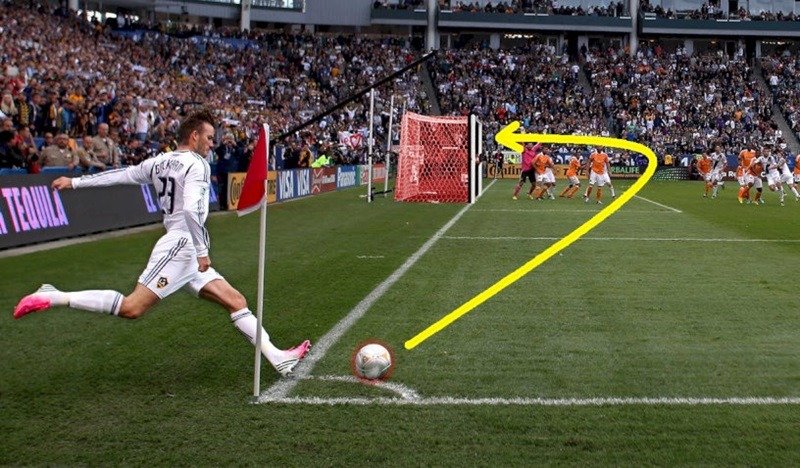
The key condition for a team to be awarded a corner kick is that a defending player must be the last player to touch the ball before it crosses the goal line. In that case, the attacking team is awarded the corner kick.
Conversely, if the ball crosses the goal line and the last player to touch it is an attacking player, the referee does not award a corner kick but instead gives the defending team a goal kick.
Standard rules for taking a corner kick
To ensure accuracy and fairness, FIFA has established strict rules governing corner kicks:
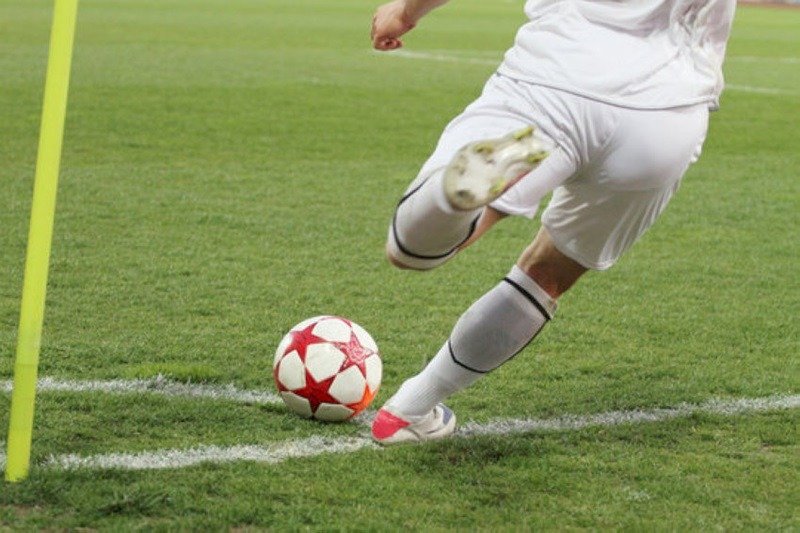
- Ball placement: The ball must be placed inside or touching the lines of the corner arc, which has a radius of 1 meter, at the corner nearest to where the ball went out of play.
- Corner flag: The corner flag marks the corner area and must not be removed or moved when the kick is taken.
- Distance for defenders: Opposing players must remain at least 9.15 meters (10 yards) away from the corner arc until the ball is put into play.
- Scoring directly from a corner: A player can score directly from a corner kick into the opponent’s goal, commonly known as an Olympico goal. However, if a player directly scores an own goal from a corner kick taken by their own team, the goal is not awarded and the opposing team is instead given a corner kick.
- Touching the ball twice: The player taking the corner kick may not touch the ball a second time until it has touched another player on the pitch.
Common corner-kick routines in modern football
Today, a corner kick is no longer simply a hopeful high cross into the penalty area. Instead, it involves detailed planning of every run and movement.
Inswinging corner kick
A left-footed player takes the corner from the right side, or a right-footed player takes it from the left. The kick creates a curling trajectory toward the goal, causing significant confusion for the goalkeeper and opposing defenders.
Outswinging corner kick
The ball is curled away from the goal toward the positions occupied by tall center-backs moving forward from deeper areas. This trajectory allows attacking players to build momentum and generate power when attempting a header.
Short corner
Instead of delivering the ball directly into a crowded penalty area, the corner taker makes a short pass to a nearby teammate a few meters away. This approach is designed to stretch the opposing defense, create a better crossing angle, or enable a coordinated attack through the half-space.
The influence of corner kicks in elite tactics
Having outstanding corner-kick specialists and center-backs who excel in aerial duels is a key factor that helps many teams break deadlocks. Numerous major matches in the Premier League and Champions League have been decided by a single cleverly designed corner routine. Studying an opponent’s defensive habits during corner kicks has therefore become an essential task for coaching assistants before every matchday.
Keeping up with the excitement of football every day
Thrilling corner-kick routines and dramatic goals are always part of what makes football so captivating. To assess the standings and the performances of clubs after each round, following kqbd hom qua has become a habit that helps fans quickly keep track of detailed developments.
Alongside keeping up with scores, enjoying smooth live coverage with crystal-clear image quality is also extremely important. Today, the brand Xôi Lạc Trực Tiếp has become a familiar destination for football fans.
Through XoilacTV, viewers can fully enjoy intense aerial battles and spectacular corner kicks from leading competitions around the world. With high-speed connections and a smooth broadcasting system, Xoilac Live accompanies fans through every exciting and immersive moment of entertainment.
Conclusion
Understanding what corner kicks are, along with the relevant rules and tactical routines, will help you enjoy exciting football matches from a deeper tactical perspective. More than just an ordinary set-piece situation, a corner kick is an art of exploiting space and timing — a moment when great goals can emerge from a small corner of the pitch.
Read more related blogs on AttitudeBios. Also join WhatsApp for more update.