
Coach Arrigo Sacchi is one of the most influential tacticians in football history, despite never having a prominent professional playing career. He built his reputation through his philosophy of pressing, zonal defending, and synchronized team organization. When xem bong da truc tiep, fans on 90Phut TV can still recognize many tactical principles developed from Sacchi’s ideas.
Arrigo Sacchi’s Journey to the Top of Coaching
Born in 1946 in Fusignano, Italy, Arrigo Sacchi played amateur football before turning to coaching. He started with smaller clubs, worked his way through the lower levels of Italian football, and gradually built a reputation through his distinctive tactical ideas. UEFA notes that he coached Rimini, worked with Fiorentina’s youth team, and helped Parma earn promotion before being appointed by AC Milan in 1987.
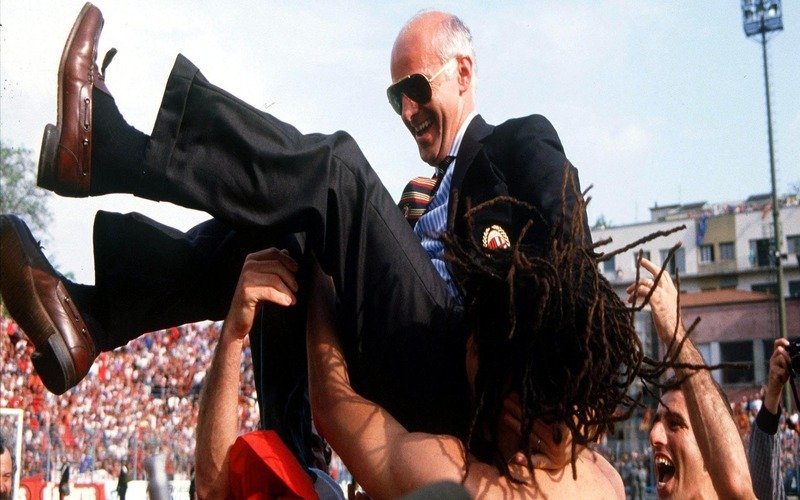
The biggest turning point in Coach Arrigo Sacchi’s career came when Silvio Berlusconi gave him the opportunity to manage AC Milan. At the time, the decision attracted considerable attention because Sacchi had no top-level playing background. However, he quickly demonstrated that coaching ability did not necessarily have to come from a distinguished playing career.
On 90p TV, historical stories about Sacchi are often mentioned as a classic example of how tactical thinking can make a difference. He did not simply build a team around the quality of individual stars; instead, he demanded that the entire system operate as one unit, from the forwards to the defensive line.
The Tactical Philosophy That Made Arrigo Sacchi Famous
The most distinctive aspect of Sacchi’s career was the way he changed how teams were organized. Rather than relying on the deep defensive approach that was common in Italy at the time, Sacchi wanted his teams to actively apply pressure, maintain compact distances, and control space.
Coordinated Pressing Across the Entire Team
One of the most important trademarks of Coach Arrigo Sacchi was systematic pressing. He required players to move together whenever the team pushed forward or dropped back, minimizing the gaps between the lines.
UEFA considers Sacchi one of the coaches who helped shape the principles of pressing, synchronized movement, and zonal defending that are now widely used in modern football.
When watching old matches or highlight bóng đá mới nhất, viewers can recognize that many modern teams still apply similar principles: forwards are not only responsible for scoring but also serve as the first line of defense, while defenders actively push the defensive line forward rather than constantly dropping deep.
Zonal Defending Instead of Simple Man-Marking
Sacchi placed particular importance on protecting space. Players were not simply expected to follow a specific opponent; they had to understand the position of the ball, their teammates, and the space behind them.
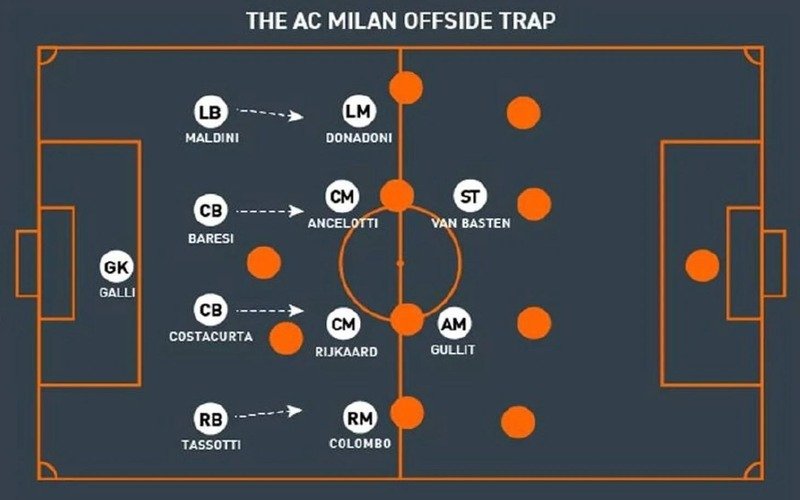
This organization required highly precise coordination. Whenever one player moved, the others also had to adjust to maintain the overall structure. This synchronization helped AC Milan under Sacchi create a defensive system that was difficult to break down, even when the team played with a relatively high defensive line.
Prioritizing the Team Over Individuals
A consistent principle throughout Sacchi’s philosophy was that the collective had to come before individual players. AC Milan had stars such as Marco van Basten, Ruud Gullit, Frank Rijkaard, Franco Baresi, and Paolo Maldini, but every player was expected to serve the overall structure.
This was also one of the factors that made Milan’s style so distinctive. On 90 Phút TV, when revisiting the team’s classic matches, viewers can see that the attacking stars were still actively pressing and contributing to the defensive system.
The 4-4-2 Formation Operating as One Unified Unit
Sacchi is often associated with the 4-4-2 formation, but the key difference was not the numbers themselves. More important were the distances between the lines and the ability of all 11 players to coordinate effectively.
When attacking, the team could quickly push forward to occupy space. When possession was lost, the entire team immediately applied pressure and reduced the opponent’s available space. This approach allowed Milan to play much more proactively than many other Italian teams of the same era.
Sacchi’s Remarkable Success with AC Milan
His early years at AC Milan elevated Coach Arrigo Sacchi to the status of one of Europe’s most renowned managers. His team not only won major trophies but also developed a style that forced many opponents to rethink their approach to matches.
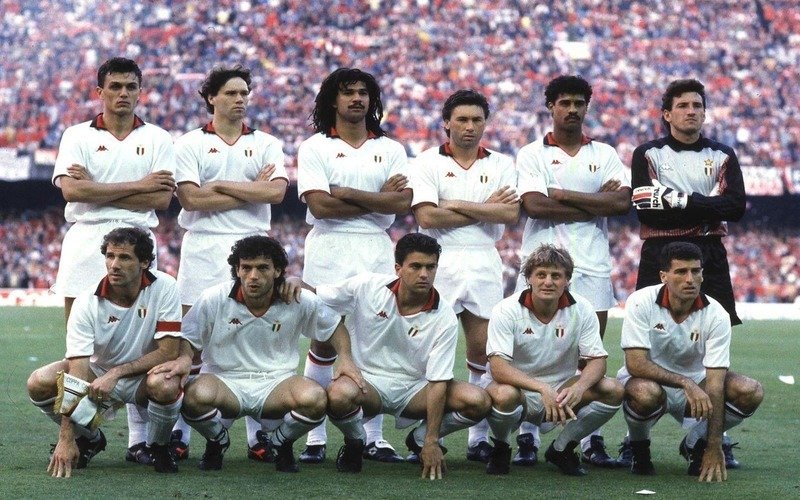
In the 1987/88 season, Sacchi guided Milan to the Scudetto, the club’s first Italian league title in nine years. The team then won the European Cup in two consecutive seasons, 1988/89 and 1989/90. AC Milan states that across Sacchi’s four seasons in charge, the club won one Scudetto, two European Cups, two European Super Cups, and two Intercontinental Cups.
This success was even more significant because Milan was not simply dependent on results. The team displayed an aggressive and proactive style of football, laying the foundations for becoming one of the most iconic sides in European football.
For those who regularly follow 90m TV, Sacchi’s Milan era also provides valuable material for comparing the development of tactics across different periods. Many principles that appear highly modern today were actually implemented by Sacchi from the late 1980s onward.
Arrigo Sacchi’s Impact on the Italian National Team
After his success at club level, Sacchi moved on to manage the Italian national team. This was an entirely different challenge because a national-team coach has much less time to train players than a club manager.
Taking Italy to the 1994 World Cup Final
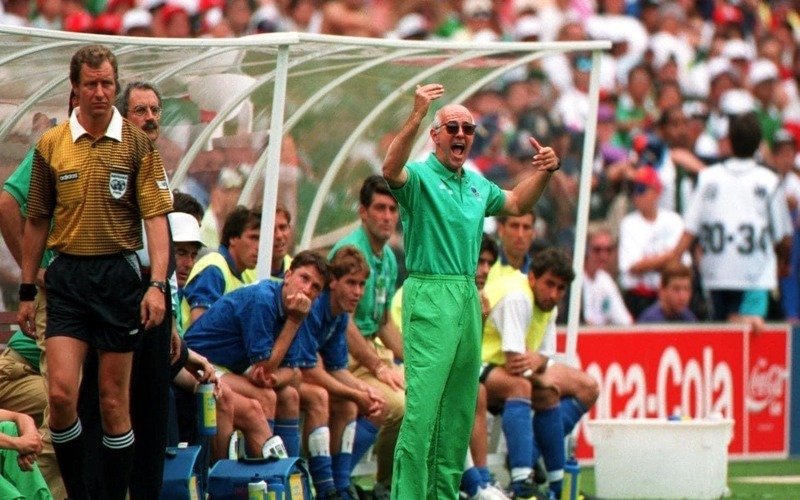
Sacchi’s most notable achievement with the Azzurri came at the 1994 World Cup in the United States. Italy did not have the easiest start to the tournament but progressed further as the competition went on, particularly thanks to the brilliance of Roberto Baggio.
Italy eventually reached the final against Brazil. The two teams drew 0-0 after 120 minutes, with Italy losing in the penalty shootout. UEFA also regards taking Italy to the 1994 World Cup final as one of the greatest achievements of Sacchi’s career.
When watching highlight bóng đá mới nhất or classic matches, fans on 90P TV can see that modern international football has also increasingly emphasized pressing organization and space control, principles closely associated with Sacchi’s philosophy.
The Difficulty of Transferring Club Philosophy to the National Team
Sacchi’s challenge lay in the fact that his philosophy required a great deal of training time. Players had to understand precisely when to press, how to maintain their distances, and how the entire team should shift together.
At international level, limited time with the squad made it more difficult to build such a complex system. Nevertheless, Sacchi still took Italy to within one step of becoming world champions, demonstrating his ability to adapt.
Controversies but a Lasting Impact
Sacchi had a strong tactical personality, meaning that some of his personnel decisions and approaches to managing the national team generated debate. However, it is difficult to deny that Italy under his leadership attempted to play with a more proactive system rather than relying entirely on traditional defensive strengths.
The Legacy Arrigo Sacchi Left on Modern Football
The influence of Coach Arrigo Sacchi extends far beyond the number of trophies he won. UEFA presented him with the President’s Award in 2022 and emphasized that Sacchi’s tactical innovations influenced many generations of coaches that followed.
From high pressing and zonal defending to the concept of the entire team moving together as a unit, many principles once championed by Sacchi have now become fundamental concepts in elite football. Carlo Ancelotti, who played under him at Milan, is among the many coaches influenced by these ideas.
When xem bong da truc tiep, viewers on 90 Phut today can see teams maintaining extremely compact formations, pressing proactively from the forward line, and constantly adjusting their positions according to the ball. These scenes demonstrate, to some extent, that the ideas Sacchi promoted continue to influence football decades later.
Conclusion
Coach Arrigo Sacchi is remembered not only for his trophies with AC Milan or his journey with Italy to the 1994 World Cup final, but also for the way he transformed football’s tactical thinking. Following 90Phut gives fans additional perspectives on tactical schools of thought and influential figures in the history of the world’s most popular sport.
Read more related blogs on AttitudeBios. Also join WhatsApp for more update.